Saturday, May 31, 2008

Second Life and EVE Online: to game or not to game


Second Life is a social, virtual 3D world, as most of you undoubtedly know. It offers a means to act out your creativity and fantasies - within certain (legal or ethical) boundaries, these days. If you want to, you can be yourself, but you can also assume a role and become part of a role playing game in Second Life. There's a lot of RPG's going on in SL: steampunk, 19th century pilots, medieval midgets, greenies, but also musicians (imitating real world bands), clubs, Gorean, raunchy stuff most of us wouldn't probably want to do in real life - and much, much more. It's all possible in Second Life: "Your world, your imagination", Linden Labs used to say.

This means that Second Life is, in itself, not a MMORPG (Massively Multiplayer Online Role Playing Game); there's no plot, no central gameplay. It's a platform that can be used to do RPG, and even MMORPG, but it certainly isn't one in itself.

For some people that's exactly what makes Second Life difficult to grasp. You log on, enter Second Life, and then what, they ask? Well, what do you want to do, who do you want to be? It's up to you!

Eve Online on the other hand is definitely an MMORPG. Even though it has a Second Life like freedom to choose your own direction, profession, activities and targets, it has an overarching gameplay and is, as such, governed by a set of principles that guide most in world activities. I can't imagine EVE Online as a venue for music, or a business meeting for instance! In this regard, EVE Online is a much more limited environment, which also requires a lot less fantasy or creativity from the players. If the SciFi setting or the gameplay do not appeal to you, there's really no reason to be there.

In short: Second Life is a platform, EVE Online is a game - that sums it up quite nicely.

Tuesday, May 27, 2008

An SL resident tries Eve online


Earlier I wrote about my decision to try out Eve online, a scifi themed virtual universe, where mining, manufacturing and trade thrive, where corporations negotiate and alliances rule, where peaceful explorers and arrogant pirates engage in fierce battle. At almost any time, some 25.000 to 30.000 players can be found online, usually engaged in one of these activities. And for the past ten days, I've been amongst them! So, what does a Second Life resident (or a Twinity citizen) think of Eve Online?

In his book "Synthetic Worlds", Edward Castronova describes several types of players in Virtual Worlds. One of those is: the explorer. Someone interested in beautiful vistas, finding out new stuff, discovering and learning. I recognized quite a lot of myself in Castronova's description, and as such I am drawn to a universe full of stars, planets, asteroids, nebulas, stations and ships. I think you can spend days travelling from region to region, stargate to stargate, without seeing the same station twice. This quality thorougly appeals to me!

And Eve Online makes it possible to be an explorer, too. Eve online and Second Life share (at least) one thing: they both don't have a defined story line. There are no predefined goals, levels, no grind, no endgame. As a commenter in one of the Eve online forums said: play *your* Eve! It's you, a couple of flying machines and a galaxy to explore. Now go and have fun! Choose your profession, and if you don't like it - just switch. Sell the mining barge, buy a destroyer and go shoot bad guys, if that's what you like.

Mining or gathering berries - what's the difference?
But make no mistake: most players in Eve are there with a goal in mind, as Eve seems to revolve around power and money - how surprising :) Gathering as much ISK (the local currency) and wielding influence through corporations and alliances is, for many, key to the game. You could say that the whole space thing is just a facade, a setting for a large political and economical game. In Eve, capitalism rules without restrictions, with a touch of violence added for good measure. The game could just as well have been set in a rainforest: early humans gathering berries or nuts, and hunting animals or enemy tribes instead of future mankind doing mining, manufacturing and space battle. It would have lacked the scifi and tech appeal, but the game could have been, essentially, the same. Come to think of it, CCP could even have used the same name!

To be human, or not to be..
As a Second Life resident, I am used to being a human shaped avatar. I have a body, which I can shape to my liking; I can keep it natural or, as Cory Linden did, go for the extreme. You can't be in Second Life without having a visible, physical body of some sort! But after ten days in Eve Online, I haven't seen my avatar yet. There's a mugshot of someone supposed to be me on my Eve login page, but I have no connection with it. My SL avatar is, at times, me; this picture in Eve Online doesn't have that appeal. "I" am a space ship, my avatar is supposed to be in there somewhere - but I don't know how it looks. This makes Eve a less immersive environment than Second Life or Twinity.

In itself this doesn't have a real impact on the game, but after a day of hard mining work, I would have liked to step out of the ship, go to Quarks' bar, and have a Pan Galactic Gargle Blaster with other miners and space cowboys. This is not currently possible in Eve Online as far as I know.

Social aspects
Does this mean there is no social interaction in Eve? On the contrary. I haven't got much experience with it yet, but interactions certainly do happen. Players unite in corporations and alliances; they mine, trade and fight together. In the Eve Online trinity client, the Local, regional and corporate chat window is open at all times, meaning you can chat with every other pilot in the neighbourhood as well as your peers in corporations and such. There's an in game mail system, and apparently people use voip applications to be able to use voice during complicated operations. And because the community is still rather small (compared to Second Life), it's still a community where many experienced players know their peers. The forums buzz with activity!

The funny thing is: in these forums, many of the complaints often hurled at Linden Labs can be heard here too. This time, obviously, aimed at CCP, the creators of Eve Online!


Money
One big difference between Second Life and Eve, is the price. I have used the Second Life free basic subscription, to my satisfaction, for quite some time; only when I wanted to buy land, I switched to a 75 dollar a year premium account. This means that SL currently costs me less than 50 euro per year. Eve online, on the other hand, is bought in days: 30, 60 or 90 day time slots can be bought at several reliable sources, be it CCP or external companies. Thirty days sets you back 15 US dollars; 90 days goes for 38.85 at the time of writing. This means that I can buy 6 months of Eve game time for the price of an annual premium SL subscription - which most players don't even need. At the bare minimum, Eve costs you twice the money the most expensive SL account costs. Eve knows no such thing as a free or basic account with limited rights; it's all or nothing.

This is quite a barrier for a casual player. The trial subscription is fourteen days; in these days (in which I also have to work, do other things, attend to my family..) I have to decide whether to spend money on this game or not. Fourteen days is way to short to get a real feel of Eve, which is much more of a long term thing than SL. SL can be rewarding quite instantly (ok, after you get off introduction island that is), where Eve requires more effort on behalf of the player to become rewarding. You need time to build up a suitable capital, something to work with, to buy the right ships and stuff. In the forums, there's talk of weeks, even months before you might get to this point! After a couple of days, I have come to the conclusion that, perhaps, CCP isn't really interested in casual users; CCP apparently goes for the dedicated, committed player.

Finally, if you decide to buy, you might not get online. Yesterday, I couldn't login because "the server was full". After a minute I got on all right, but still.

Verdict: enticing environment, I like it, but not sure whether to buy or not.

Thursday, May 22, 2008

Mining with the Imicus


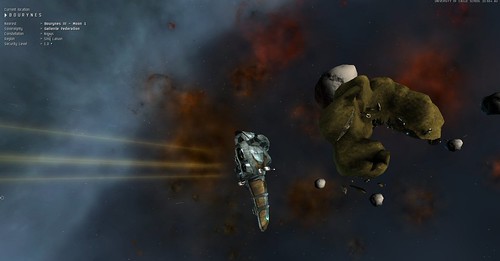
Mining with the Imicus, originally uploaded by seredwoollahra.


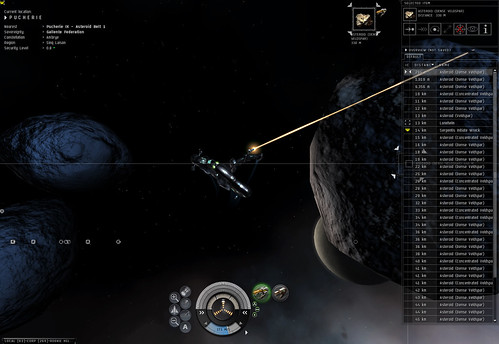
Tonight I discovered one of the big drawbacks of EVE Online: someone shot my spaceship to pieces when I wasn't paying attention. So I had to buy a new one, the Imicus - just when I thought I had earned enough money to buy myself some nice free game time :-/

Monday, May 19, 2008

EVE online and Twinity on Wine - almost..

Yesterday I booted into Windows - for the first time in weeks - to try out EVE online, because I couldn't get the 'native' Linux client to work, and Wine wouldn't do either. I kept getting a black screen after EVE Online started - quite frustrating, as I had implemented all solutions I was able to find using Google! Today I upgraded to Wine 1.0 RC1, and suddenly EVE Online started to work! Not flawlessly, but at least I was able to get in.

There is, however, another Windows bound game I'd like to run on Wine, and that's Twinity. I have been active in the beta for some time, but as I'm really almost exclusively using Ubuntu these days, my Twinity activity - never that much to begin with - has dropped to virtually zero. Hence todays' attempt to get it running on Wine!

I think I'm almost there; after downloading and installing the Twinity client, I soon found out I had to install the Visual C++ 2005 redistributable libraries (msvcp80,msvcr80 and the accompanying manifest file) to get it to work; the package is called vcredist_x86.exe. After that I still missed vcomp.dll; copied that one from my windows partition and pasted it into Twinity's bin directory. Upon starting, it now throws these errors:

me@laptop:~/.wine$ wine "C:\Program Files\Metaversum\Twinity\bin\twinity.exe"
fixme:actctx:parse_depend_manifests Could not find dependent assembly L"Microsoft.VC80.CRT"
err:module:attach_process_dlls "MSVCR80.dll" failed to initialize, aborting
err:module:LdrInitializeThunk Main exe initialization for L"C:\\Program Files\\Metaversum\\Twinity\\bin\\twinity.exe" failed, status c0000142


I have the Microsoft.VC80.CRT file, I'm just not sure where to put it!

By the way, the easiest method to install these libraries is this script: winetricks. It's a great tool! Copy it from the site, paste it in a new file, e.g. 'winetricks.sh', and save it. Set it to executable for the user (chmod 755 your_username) and execute it: ./winetricks.sh. It presents you with a nice gui box that lets you select the correct packages, downloads them from Microsoft, and installs them for you. Good job!

Unfortunately, though, it didn't solve the problem above. Wine and Twinity do start, but there's a runtime error, and in the console the error above is still printed.

Sunday, May 18, 2008

First flight @ EVE Online


First flight @ EVE Online, originally uploaded by seredwoollahra.

Using Wine, I managed to install EVE Online on Ubuntu; but when it starts, all I get is a black screen. I've implemented all the suggestions I googled; no luck. So I booted into Windows and started EVE Online from there.

It's a bit weird to be a total n00b again; I feel clumsy and sometimes I am unable to complete parts of the first training. I haven't seen my avatar again; after setup is done, you start in a spaceship for these first training missions.

It's a 14 day trial subscription; let's see how far I can get in those two weeks. If only I had more spare time ;-)

EVE online: worth the hassle?

I've been active in Second Life now for quite some time, and yesterday I decided to explore other worlds as well. I am simply curious as to how these other worlds function and wether they have something different to offer. After checking out what other worlds are available on Linux, I decided to go ahead with the 14 trial of EVE Online. There's a native Linux installer for EVE Online, based on Cedega, which I wanted to try out.

Downloading the install/config tool was easy, as was registering. But, unfortunately, I have not been able to get the installer running! It always yields errors about Python versions, missing runGUI files etcetera. It seems more people are suffering from these, but Google doesn't have a solution for me - so far.

Any experiences out there, with running EVE Online? Is it worth the hassle?

Monday, May 12, 2008

Landing at a Kelly auditorium

I'm usually flying at Caledon, but I've discovered it's quite funny to fly elsewhere - for instance at corporate sims where a sandbox is available to rezz stuff, like Kelly Services headquarters. There was no one else around at the time, so I deemed it safe for a quick flight!

This is one in the series 'weird landings where no one got hurt'. While flying around Kelly Services sims, I accidentally flew in this auditorium while my SL screen was blocked by another application's popup; my avatar landed his plane there all by himself.

Sunday, May 11, 2008

Landing on a Bay City road


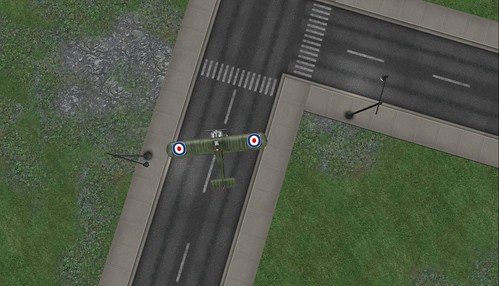
Landing on a Bay City road, originally uploaded by seredwoollahra.

This was actually not an easy landing, between all those lamp posts. There were no other motorists on the road, however..

Uploaded by seredwoollahra on 11 May 08, 12.46AM CEST.

Flying over Bay City


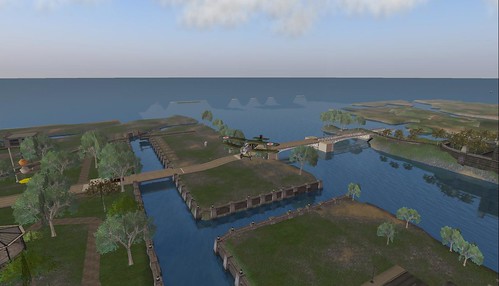
Flying over Bay City, originally uploaded by seredwoollahra.


Of course I had to try this: flying over the new Bay City regions. I was able to rez the plane at Barcole, and managed to fly a few rounds over the main Bay City sims, before the 1.20 RC6 viewer crashed on me - again.

Uploaded by seredwoollahra on 11 May 08, 12.28AM CEST.

Saturday, May 10, 2008

Bay City - urban SL


The all new and shiny, double primmed Bay City area is now open for avatar inspection. Quite a lot of visitors, but still a lot of empty spaces - as was to be expected, it's brand new after all.

Before visiting Second Life, I thought of it as a big city, an urban environment. Instead, it turned out to be much more park like, with lots of green, and open spaces. But now it looks like Bay City is intended to be the urban environment I once thought SL was.

Monday, May 5, 2008

OT: should I be using Picasa?

This is probably a bit off topic, but I wonder if anyone can tell me: who owns the rights to pictures posted on Picasa web albums? Recently, I've been using Picasa Web Albums to store some pictures of a holiday; mostly because it's so easy to upload them using Picasa on the desktop (yes, on Ubuntu too).

Now, I have used other online picture sharing sites (see for instance Flickr, Panoramio) and there's one big difference between Picasa and those others: the rights of the content owner are not explicitly mentioned on Picasa.

Panoramio explicitly mentions: "© All rights reserved by 'username'". By default, Picasa only says "download album" and "order prints"...that's completely the other way around! And will I be reimbursed when someone orders prints of my pictures (highly unlikely, I know)? I guess not, but obviously if prints are ordered, someone is making money off my pictures. I guess that would be Google, not me.

If you peruse the Picasa ToS, it only talks about the relation between Google and me, the Picasa web album owner, and how Google is allowed to use my pictures 'for promotional situations'. In the Picasa web album help, there is one chapter that deals with copyrights, but it only covers complaints of copyright owners who claim their pictures were uploaded to Picasa illegally.

So where does that leave me? My rights as content creator and owner should be mentioned explicitly somewhere, shouldn't they? Should I not be using Picasa?

Sunday, April 27, 2008

vBusiness expo wrapup

Today was the last day of the first vBusiness Expo event. Unfortunately I entirely missed this last day; I was not able to make it this time. I don't know if the last day was as good as the first three, but I defintely enjoyed those. Great event, and I'm very curious as to what will happen the next edition, later this year. In the mean time Clever Zebra is organising an event for executives who want to get up to speed with this virtual world stuff: vBusiness Executive Bootcamp. Given my current work description, I can't probably attend this one, though.

I knew there was going to be a special announcement by Kelly Services and Clever Zebra; I managed to miss that one by a couple of minutes, too. But, from several blog sources I have read, that Kelly will be offering in world staffing for companies that need representation in Second Life. There's also a link with Clever Zebra, who are also offering in world services, possibly in combination with Kelly. Man, I should have known this before taking that other job a few weeks ago :-)

I'll be offline for a couple of days, enough time to think it all through. See you next weekend!

Unreadable menu, 1.19.1.4 on Linux

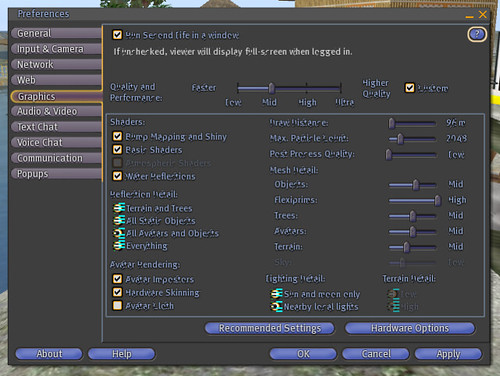
My experiences with the release candidates of the 1.20 viewer on Linux Ubuntu are very positive. Today however I noticed an interface issue with 1.19.1.4 on the same platform: the text in the preferences menu (but also the inventory) is garbled and almost unreadable. The text on the main menus and the menu selectors is, however, rendered correctly, so this is perhaps an issue with fonts!

Saturday, April 26, 2008

vBusiness Expo day 3 - Session fragments

Today is saturday, the third day of vBusiness Expo. A saturday is, however, also a family day, and so far I haven't been able to catch more than a few fragments of presentations.

First, I managed to attend quite a chunk of todays keynote by IBM's Sandra Kearny. A few of the gems she shared with us:
-We're growing from 2D internet to 3D internet. Even though it's a really fast paradigm shift, it's evolution, not revoluton.
-Personally, she sees no difference between real life and virtual life. Both are just places to be or work.
-Nobody owns the 3D internet, which is obviously a good thing!
-The 3D internet is 'broadband to the mind', it's the sensory web. You can feel a sense of human connectedness over the internet.
-Machinima will be to this generation, what Powerpoint was to the previous.

Unfortunately I had to leave here; I returned more than an hour later, only to catch the closing remarks of Eilif Trondsen's presentation on "Collaborative Work in Virtual Worlds". He was talking about research they had done; they collected real world data on how people from different industries thought about adoption of virtual worlds in their own sector, for instance in the oil industry. Even though I only caught the last sentences, I'm definitely going to download his slides, which will be made available for download - probably at Clever Zebra.

After a short break, the next speaker hits the stage: Scott Randall, Brand Games. The agenda doesn't tell what he will be speaking about; it turns out to be on employment issues and virtual worlds. Throughout Scott's session, I have to tend to the kids, so I may have missed something here and there.

As wasmentioned in other sessions as well, Scott talked about the babyboomers, on their way out of the workforce. The new generation is smaller, and literate in a completely different way; they can multitask, looking at multiple information sources on one screen etcetera. As Scott said: most of you are probably multitasking while listening to this presentation.
So how are these companies going to engage the new workforce, while still being led by those babyboomers? We need knowledge transfer; perhaps the transfer of knowledge from traditional media to interactive media. You need to provide your employees with information in a way they see fit!

Scot mentioned a project his company Brand Games did for Deloitte. They built a dedicated mission based virtual world. Game roles were modeled after Deloitte's top performers; a great way to check out wether you would fit in such a role, if you would fit at Deloitte. A risk free simulation of what will happen in the real world.

Scott likes to work with proprietary worlds; a female executive of a customer was once harassed in world, leading to that companies' withdrawal from SL. Also, if it's your own virtual world, you have more control over availability etcetera.

I'll grab a cup of coffee now, bring the kids to bed - meaning I will miss the next session, a panel on "Perspectives on the future of Second Life and other virtual spaces for education". Interesting subject, good panel, but you can't have everything..

vbusinessexpo day2: Metanomics


vbusinessexpo_metanomics, originally uploaded by seredwoollahra.

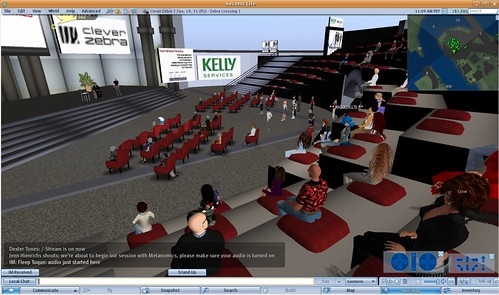
A view of the audience for yesterdays' Metanomics session. What's nice about these sessions, is the immediate discussions taking place in the backchatter of, for instance, the Second Life group Metanomics. Not only is useful information provided in these discussions; they also foster a sense of community. Part of that backchatter is visible in this screenshot.

By the way, this is viewer version 1.20 RC4 on Ubuntu Linux 8.04. It is amazingly stable; while other users complained about multiple viewer crashes in one evening, I had none.

Friday, April 25, 2008

vBusiness Expo day 2: Virtual worlds and the law

This second session I was able to follow, featured a panel discussion on 'Virtual worlds and the law', hosted by noted blogger and lawyer Benjamin Duranske of Virtually Blind. Again I had to tend to family business during the session, so I didn't get all of this.

Second Life, and games in general, bring issues of trademarks, counterfeiting brands or goods in world and related issues. A brand may want to enforce a trademark in world, even when there's no direct risk or damage involved, purely to maintain control over their own brand. For small entrepeneurs in Second Life this may prove difficult to do however, because of the cost of litigation. But, there are however examples of successful litigation in trademark cases, even though the two most clear examples were settled out of court, before the merits of the case were clear.

There were some very interesting discussions concerning what law and jurisdictions apply in employment situations. People in Second Life come from all over the planet; if someone pays an avatar to work with him on, say, building a sim, what jurisdiction does apply? You might not even know where that other avatar is coming from in real world, so how are you going to be compliant with employment law? These are, as was said, "highly complex legal relationships".

Another area of discussion is the enforceability of contract in a virtual world. Again, it is not always clear what law applies and what jurisprudence is valid. In some cases, a contract might only be enforceable if both parties want to comply.

This was really a very interesting discussion, and it's too bad I didn't get all of this. But sometimes, RL family has to take precedence over SL discussions - that's the legal precedent in our family ;-)

For those interested in this subject, I refer you to Virtually Blind, Benjamin's blog on virtual law.

A question I'd like to see discussed sometimes, is wether there's a difference between SL and an OpenSim grid. Linden Labs banned certain behaviours and busineses in order to comply with US law. But what happens when a grid consists of simulators hosted by different companies and individuals, all over the planet? Plus, the owner of a sim may reside in a different country than where his sim is actually hosted. In situations like these, what law apply? Could you possibly end up with a grid where you can't gamble in region x, but are fully free to do so in region y? Could that be feasible, or even enforceable? Maybe jurisprudence from the internet could apply there, where servers are also hosted all over the planet?

vBusiness Expo day 2: Metanomics Special


After some initial delays, I was able to catch the vBusiness Expo session hosted by Metanomics' Robert Bloomfield, who had a very interesting discussion with Larry Johnson of the New Media Consortium.

After a short introduction, Robert interviews Larry, who, at the time of the interview, is somewhere on an airport! Larry recently recently testified for the US Congress hearing on virtual worlds.

NMC views SL generally as a venue for educational gaming; Larry proceeds to tell more about NMC's activities in world. Around this part of the meeting I suffered quite heavily from KI - Kids Interference - so I didn't get all of this, I am afraid. When I returned to the discussion, Larry was talking about what museums are doing in SL. He said these museums are definitely watching what's going on, but he didn't expect much activity in world from them.

NMC's business model is "self sustaining". So what does that mean? Larry explains that NMC has two business strategies in world. First, NMC has a virtual land business, really much like the Anche Chung, but targeted specifically at educational institutions. To them NMC is a reliable partner, and this creates a safe place for these institutions to get in world. This is, in the second place, in line with NMC's mission. Their aim with this land business was to recover cost, which is working out really well.

Q: What is the value proposition for prospective customers to work with NMC?
Larry answers: we don't sell our services, that's not what we're about. We help institutions figuring out this new palce, and we bring a real interest in teaching and learning to the table. We know this landscape really well. In 2007, we were looking to help people to understand this place. In 2008 we still do that, but we're also really interested in architecture. You don't need to provide shelter in SL, so architecture in SL needs to meet different needs. We are thinking about that. NMC is fairly picky about their projects; we are really trying to accomplish something. We don't take each project that's offered to us. So this makes us really different from other builders in world.

Q: you didn't want to sell, but that was a very convincing pitch :-)

Q: Some questions on government policy. In your testimony before Congress, you said: when the US expanded westward, land was reserved for universities. Energy, power was brought to rural areas because a law ordered it, not for profit. So whwat should government do now?
A: The government is not helping us to be a leader in this world. The US is lagging in broadband, for instance. Other countries (Larry specifically mentioned Japan) have a much higher broadband penetration, and much higher speeds. Same for mobile broadband. Clearly, it's not in the nations best interest to deregulate this sector. we could benefit from some regulation here. We need policies to bring this up to speed. Second, we need to invest in the internet like we did in the early 1990's. Finally, we need programs to bridge the digital divide.

Q: is the NMC a lobbyist group?
A: No, our charter does not allow that, but I was invited to testify; it was an expert testimony.

Q: what challenges and opportunities do enterprises face in the virtual world? What challenges do educators face? There is definitely 'game taint'. "Oh, there's the gamer guy, he has an avatar! They probably need a support group, like avaholics anonymous". One of the ways to address this is probably like Fleep said yesterday: have a businesslike demeanor, dress and behave appropriately. Is that the kind of advice you would give to educators and enterprises? And to what extend is NMC an advisor?
A: Fleep had some very good points. I wouldn't wear this unbuttoned shirt to a formal meeting. We're continuously thinking about the things Fleep mentioned. This is serious business. NMC did sessions in world, and we noticed people got in world because they were interested in the topic, not because it was novel. It's not really novel anymore. One of the things that makes this place more compelling though is because you can do more in this environment than in a video conference or a conference call. We try and showcase those extra things as long as they are relevant to the context, be it art or education. It has to be relevant, and it has to fit the context.

Here, both in the backchatter as on stage, an interesting discussion ensues about how an avatar should look and what is appropriate.

Finally, Robert asked some specific questions on liabilities and responsibilities for educators when they bring students in this virtual world, maybe exposing them to harassment or some such thing along the way. Luckily, as Larry said, NMC did some research into this matter and was not able to dig up a single incident in their customer groups. But, it is a legitimate source of caution, even though NMC's project are pretty safe, with their own orientation and an environment that's clearly about teaching and learning.

Robert followed this up with a somewhat related question: are people spending more hours a day in virtual worlds than they should, as was asked during the congressional hearings?
Larry said again, no, he didn't see a cause for concern. Often students who spend much time in world have swapped out TV time for SL time, which Larry considers a good thing. An immersive, active virtual world is perhaps a better place to spend time than sitting in front of the TV all evening. We are, says Larry, part of the solution, not the problem here. Larry mentioned an amazing tidbid: students spend on average 52 minutes per visit on an NMC project. Pretty remarkable for one signle visit, especially compared to the time people spend on an ordinary web page.

Finally: last week, at Metanomics, Steve Prentiss from Garnter expressed some grave concerns about Second Live as a viable venue for enterprises. He has no doubts on virtual worlds per se, but was quite bearish on SL, expressing concerns around the steep learning curve, hardware demands, and availability/stability issues. Says Robert: "Some pretty valid concerns there". So why does NMC do Second Life?

Larry: I don't agree with Steve. SL is not a good fit for enterprises if they keep doing it as they did in the past years. They didn't study the culture, there was no understanding, and they tried to retrofit, bolt old ideas on this new thing - that didn't work. It's a waste of money and time, to get in world like that. As for technical issues: companies need to discover reasons why there might be value in virtual worlds for them. When they are ready for that, investments in hardware will come, and technical issues will be resolved.
Second Life is the early leader. The seminal first instance of whatever this becomes! At the same time, people ask SL to be things that it wasn't built to be, like a secure meeting space for meetings with customers, or a DoD training ground. Some expectations were perhaps a little unfair to Linden Labs. Remember, this is called Linden *Labs*, they were running a big experiment until fairly recently. But as for availability, there have been big improvements recently.

And here, running out of time, Robert concluded this highly educational and interesting session.

A few quick thoughts on vBusiness Expo

Expanding on what I wrote yesterday, a few points regarding vBusiness Expo.

First, it feels like a real conference, minus the travel and the stay in a hotel. To some that may be a drawback, I know ;-) It's really an immersive event; to me it's proof of the value of virtual worlds for business all by itself.

Second, I didn't have a viewer crash. Not once! People around me were complaining about viewer crashes; not me. I ran the 1.20 RC3 client on Ubuntu 8.04, so I was quite amazed by the apparent stability of my client.

Third, one for the speakers: slides need a little time to 'rez' in SL. We, in the audience, get the blurry picture first; it takes a while before it gets sharper and we can read what's on it. So, please, give us time to read the slide before moving on to the next one!

Fourth, I think the speakers use Skype to communicate and talk to us. While they were obviously using the voice part, there were also Skype chat messages being sent and received. So we, in the audience, would keep hearing those Skype new message pings, which can be very distracting if you're a Skype user yourself! Each time I heard that ping, I was tempted to see where the new message window was.. In the end, I shut down my own skype and decided to ignore it for the rest of the evening.

Finally: smart move to divide the main stadium over four sims, thus spreading server load.

Thursday, April 24, 2008

vBusiness Expo: Taking brands into Virtual Worlds

In this vBusiness Expo session Nic Mitham, KZero CEO and good friend of Clever Zebra, talked about "Taking brands into virtual worlds". A very interesting session with, for perhaps the first time ever, the results of an in world marketing campaign presented and discussed.

There is a difference, Nic explained, between the rationale for B2B and B2C use of virtual words. The first one centers around internal communication, recruitment, positioning and prototyping and such. The second one, business to customer, has a different rationale. It centers around concepts of target market, a new customer engagement channel, research prototyping and R&D, and (perhaps the biggest opportunity) virtual goods revenue stream.

Principles
So how should a brand go into a virtual world? Nic detailed seven steps to take into account:

1. Have a plan! Sit down and plan it. There are lots of different virtual worlds available, which one suits your needs in terms of target market, for instance? That doesn't necessarily have to be Second Life; different worlds have different audiences. After you choose a world, define clear objectives. Don't go in saying "we're going in to test it".

2. Design is an output, not an input. The design of your in world presence should be a result of your plan. Buying an island and building a big shiny office there isn't a goal in itself! Think small, simple, think building blocks. Then you can scale it if necessary.

3. Integrate. Take a look at what marketing activities (product launch, advertising campaign) the business has going in real world, and dovetail the virtual activities on those. Don't present the virtual world activity as an isolated event.

4. Giving is better than receiving: bring your brand, your marketing information to the people. They won't keep coming to your island for the shiny building and the ferris wheel. Disseminate your information to the target audience; Nic didn't say it, but he obviously didn't mean you should spam your target audience. In the L'Oreal case study, he talked more about this.

5. Keep the seats warm. If you have an in world venue, be it a shop or an island, you have to have people representing your brand there, in world. Employees or, for instance, hired and trained avatars as "brand ambassadors".

6. Stoke the fire: run events, with the brand as a focal point.

7. Promote and cross promote: use print and web advertising to advertise your in world activities. A kind of meshing between RL and SL activities; what happened around "CSI:NY" and "I am legend" are early examples of this kind of promotion.

L'Oreal
Based on these principles, KZero created an in world campaign for L'Oreal Paris, in october 2007. There was a concise project brief from L'Oreal, which basically said they wanted to provide a dedicated, rich experience to their customers, with the central idea to enable avatars to look atractive - as acttractive as some of the real world models of L'Oreal.

So, 'beauty' became the key plan. Other key points: engage the SL target market on their terms; avatars are rarely ugly; L'Oreal doesn't own stores in real world; try to link the virtual activities to RL products.

A couple of skins were developed, based on RL models like Penelope Cruz and Scarlett Johansson, to tap into the whole 'beauty' thing. It was decided that these skins would not be sold on a separate L'Oreal island. Islands have issues; for instance, they are *islands*! An island creates distance between the brand and the consumers, the residents. After all, most avatars really hang out on the mainlands. The solution was to place the L'Oreal products at six selected existing stores. Stores with existing, loyal and frequently returning visitors, stores that are almost a metabrand in their own right.

Also, KZero worked with Rezzable to place a handbag in the famous Greenies kitchen, which still attracts a lot of visitors. Real life products were recreated at a 'larger than life' scale, and put in a handbag which got placed in the kitchen. Nothing more, nothing less; a really subtle and inobtrusive way of product placement. I think this is what Nic meant by "bringing your brand to the customer"; this is obviously much better than spamming your clientele!

And, KZero applied some advertising here and there, mostly in media that exclusively target SL residents. In Second Style for instance, ads were placed that were made to look as identical to real world L'Oreal ads as possible.

After this was all done, there wasn't much left to do except for processing feedback; there was no island to maintain!

It soon became clear that the skins were very well received; residents started emailing pictures of themselves in these skins, which is great. These pictures were posted to Flickr.

Evaluation
Then, Nic proceeded to share the L'Oreal campaign results with us. He believes this is the first time such a thing happens; usually companies sent out press releases at the start telling how great it will be, but they never report back. Kzero did it the other way around; no press release at the beginning, but we will get to hear how it went.

And it went amazingly well. Overall, 34.000 skins were sold, at these six stores, in a couple of weeks - at an average of 2000, 2500 a week. From those sales, almost three quarters came from two of the six shops; Nic declinded to tell which shop sold how much, mostly to 'protect the innocent'!

Due to a technical issue at Nick's side, there was no opportunity to ask questions. I had one in mind, frankly: is it clear why those two unnamed shops outperformed their competitors with such big margins? They were, after all, selling the same product to the same audience in essentially the same market. So what were the differences? There must be a valuable lesson there for all SL fashion shop owners, and I bet they're eager to hear it.

The slides for this session, including ad samples etcetera, can be viewed here, at KZero.co.uk. Please do take a look!

vBusiness Expo day 1 wrapup

Tonight there were three more sessions I have written notes for, but I haven't got the time to work them out right now. I must say I'm generally impressed with the level of the speakers; especially Nic Mitham of KZero, who had an impressive session on 'bringing brands to virtual worlds'. I'll try to work those notes out later this evening.

Big compliments to Clever Zebra for putting this together - great show so far. I don't know if I'll be able to follow as many sessions in the coming days as I did tonight, but I hope I will be. It's definitely worth the while.