Showing posts with label vbusiness expo. Show all posts

Saturday, March 21, 2009

Virtual conferences, again

Funny how, at the end of the hype cycle, stuff from the earlier days seems to return! One of the reasons for me to become a Second Life resident, was IBM's involvement; more specifically, the IBM Lotus guys seemed very active there. And again it's IBM and IBM Lotus people who pick up where they left off a while ago. A few weeks ago we noticed the IBM and Linden Labs case study on conferences in Second Life. And now, via Massively, we get the Beyond Blogging conference, organised by IBM's Jo Grant a.k.a. Jaymin Carthage. This conference is about..

..Wouldn't it be great, I thought, if we could do a conference where we could talk about what was important to use: how we use virtual worlds in our work and personal life.


This event is slated to take place on April 7 and 8, and it looks like it's going to be an interesting event. I plan to spend some time there, if I can! Tateru said, in her Massively writeup, that non IBM people who wish to attend, need an IBM sponsor, but, having read Jo's blog entry, I do not think that she's right. Non IBM people are free to attend, they just need an IBM sponsor if they want to present or speak at the conference.. I'm sure someone will correct me if I'm wrong!

But IBM isn't alone. The Clever Zebras are at it again, too: the third vBusiness Expo is planned for May 2009. I visited a lot of the sessions at vBusinessExpo 2008, and I still regard it as a changing experience, where the power of conferences and meetings in virtual worlds became obvious to me. Keep an eye on this one, and register if you can!


IBM:

Sunday, April 27, 2008

vBusiness expo wrapup

Today was the last day of the first vBusiness Expo event. Unfortunately I entirely missed this last day; I was not able to make it this time. I don't know if the last day was as good as the first three, but I defintely enjoyed those. Great event, and I'm very curious as to what will happen the next edition, later this year. In the mean time Clever Zebra is organising an event for executives who want to get up to speed with this virtual world stuff: vBusiness Executive Bootcamp. Given my current work description, I can't probably attend this one, though.

I knew there was going to be a special announcement by Kelly Services and Clever Zebra; I managed to miss that one by a couple of minutes, too. But, from several blog sources I have read, that Kelly will be offering in world staffing for companies that need representation in Second Life. There's also a link with Clever Zebra, who are also offering in world services, possibly in combination with Kelly. Man, I should have known this before taking that other job a few weeks ago :-)

I'll be offline for a couple of days, enough time to think it all through. See you next weekend!

Saturday, April 26, 2008

vBusiness Expo day 3 - Session fragments

Today is saturday, the third day of vBusiness Expo. A saturday is, however, also a family day, and so far I haven't been able to catch more than a few fragments of presentations.

First, I managed to attend quite a chunk of todays keynote by IBM's Sandra Kearny. A few of the gems she shared with us:
-We're growing from 2D internet to 3D internet. Even though it's a really fast paradigm shift, it's evolution, not revoluton.
-Personally, she sees no difference between real life and virtual life. Both are just places to be or work.
-Nobody owns the 3D internet, which is obviously a good thing!
-The 3D internet is 'broadband to the mind', it's the sensory web. You can feel a sense of human connectedness over the internet.
-Machinima will be to this generation, what Powerpoint was to the previous.

Unfortunately I had to leave here; I returned more than an hour later, only to catch the closing remarks of Eilif Trondsen's presentation on "Collaborative Work in Virtual Worlds". He was talking about research they had done; they collected real world data on how people from different industries thought about adoption of virtual worlds in their own sector, for instance in the oil industry. Even though I only caught the last sentences, I'm definitely going to download his slides, which will be made available for download - probably at Clever Zebra.

After a short break, the next speaker hits the stage: Scott Randall, Brand Games. The agenda doesn't tell what he will be speaking about; it turns out to be on employment issues and virtual worlds. Throughout Scott's session, I have to tend to the kids, so I may have missed something here and there.

As wasmentioned in other sessions as well, Scott talked about the babyboomers, on their way out of the workforce. The new generation is smaller, and literate in a completely different way; they can multitask, looking at multiple information sources on one screen etcetera. As Scott said: most of you are probably multitasking while listening to this presentation.
So how are these companies going to engage the new workforce, while still being led by those babyboomers? We need knowledge transfer; perhaps the transfer of knowledge from traditional media to interactive media. You need to provide your employees with information in a way they see fit!

Scot mentioned a project his company Brand Games did for Deloitte. They built a dedicated mission based virtual world. Game roles were modeled after Deloitte's top performers; a great way to check out wether you would fit in such a role, if you would fit at Deloitte. A risk free simulation of what will happen in the real world.

Scott likes to work with proprietary worlds; a female executive of a customer was once harassed in world, leading to that companies' withdrawal from SL. Also, if it's your own virtual world, you have more control over availability etcetera.

I'll grab a cup of coffee now, bring the kids to bed - meaning I will miss the next session, a panel on "Perspectives on the future of Second Life and other virtual spaces for education". Interesting subject, good panel, but you can't have everything..

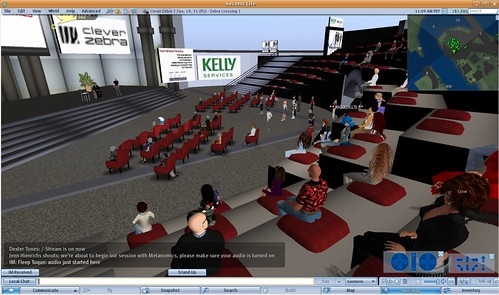
vbusinessexpo day2: Metanomics


vbusinessexpo_metanomics, originally uploaded by seredwoollahra.

A view of the audience for yesterdays' Metanomics session. What's nice about these sessions, is the immediate discussions taking place in the backchatter of, for instance, the Second Life group Metanomics. Not only is useful information provided in these discussions; they also foster a sense of community. Part of that backchatter is visible in this screenshot.

By the way, this is viewer version 1.20 RC4 on Ubuntu Linux 8.04. It is amazingly stable; while other users complained about multiple viewer crashes in one evening, I had none.

Friday, April 25, 2008

vBusiness Expo day 2: Virtual worlds and the law

This second session I was able to follow, featured a panel discussion on 'Virtual worlds and the law', hosted by noted blogger and lawyer Benjamin Duranske of Virtually Blind. Again I had to tend to family business during the session, so I didn't get all of this.

Second Life, and games in general, bring issues of trademarks, counterfeiting brands or goods in world and related issues. A brand may want to enforce a trademark in world, even when there's no direct risk or damage involved, purely to maintain control over their own brand. For small entrepeneurs in Second Life this may prove difficult to do however, because of the cost of litigation. But, there are however examples of successful litigation in trademark cases, even though the two most clear examples were settled out of court, before the merits of the case were clear.

There were some very interesting discussions concerning what law and jurisdictions apply in employment situations. People in Second Life come from all over the planet; if someone pays an avatar to work with him on, say, building a sim, what jurisdiction does apply? You might not even know where that other avatar is coming from in real world, so how are you going to be compliant with employment law? These are, as was said, "highly complex legal relationships".

Another area of discussion is the enforceability of contract in a virtual world. Again, it is not always clear what law applies and what jurisprudence is valid. In some cases, a contract might only be enforceable if both parties want to comply.

This was really a very interesting discussion, and it's too bad I didn't get all of this. But sometimes, RL family has to take precedence over SL discussions - that's the legal precedent in our family ;-)

For those interested in this subject, I refer you to Virtually Blind, Benjamin's blog on virtual law.

A question I'd like to see discussed sometimes, is wether there's a difference between SL and an OpenSim grid. Linden Labs banned certain behaviours and busineses in order to comply with US law. But what happens when a grid consists of simulators hosted by different companies and individuals, all over the planet? Plus, the owner of a sim may reside in a different country than where his sim is actually hosted. In situations like these, what law apply? Could you possibly end up with a grid where you can't gamble in region x, but are fully free to do so in region y? Could that be feasible, or even enforceable? Maybe jurisprudence from the internet could apply there, where servers are also hosted all over the planet?

vBusiness Expo day 2: Metanomics Special


After some initial delays, I was able to catch the vBusiness Expo session hosted by Metanomics' Robert Bloomfield, who had a very interesting discussion with Larry Johnson of the New Media Consortium.

After a short introduction, Robert interviews Larry, who, at the time of the interview, is somewhere on an airport! Larry recently recently testified for the US Congress hearing on virtual worlds.

NMC views SL generally as a venue for educational gaming; Larry proceeds to tell more about NMC's activities in world. Around this part of the meeting I suffered quite heavily from KI - Kids Interference - so I didn't get all of this, I am afraid. When I returned to the discussion, Larry was talking about what museums are doing in SL. He said these museums are definitely watching what's going on, but he didn't expect much activity in world from them.

NMC's business model is "self sustaining". So what does that mean? Larry explains that NMC has two business strategies in world. First, NMC has a virtual land business, really much like the Anche Chung, but targeted specifically at educational institutions. To them NMC is a reliable partner, and this creates a safe place for these institutions to get in world. This is, in the second place, in line with NMC's mission. Their aim with this land business was to recover cost, which is working out really well.

Q: What is the value proposition for prospective customers to work with NMC?
Larry answers: we don't sell our services, that's not what we're about. We help institutions figuring out this new palce, and we bring a real interest in teaching and learning to the table. We know this landscape really well. In 2007, we were looking to help people to understand this place. In 2008 we still do that, but we're also really interested in architecture. You don't need to provide shelter in SL, so architecture in SL needs to meet different needs. We are thinking about that. NMC is fairly picky about their projects; we are really trying to accomplish something. We don't take each project that's offered to us. So this makes us really different from other builders in world.

Q: you didn't want to sell, but that was a very convincing pitch :-)

Q: Some questions on government policy. In your testimony before Congress, you said: when the US expanded westward, land was reserved for universities. Energy, power was brought to rural areas because a law ordered it, not for profit. So whwat should government do now?
A: The government is not helping us to be a leader in this world. The US is lagging in broadband, for instance. Other countries (Larry specifically mentioned Japan) have a much higher broadband penetration, and much higher speeds. Same for mobile broadband. Clearly, it's not in the nations best interest to deregulate this sector. we could benefit from some regulation here. We need policies to bring this up to speed. Second, we need to invest in the internet like we did in the early 1990's. Finally, we need programs to bridge the digital divide.

Q: is the NMC a lobbyist group?
A: No, our charter does not allow that, but I was invited to testify; it was an expert testimony.

Q: what challenges and opportunities do enterprises face in the virtual world? What challenges do educators face? There is definitely 'game taint'. "Oh, there's the gamer guy, he has an avatar! They probably need a support group, like avaholics anonymous". One of the ways to address this is probably like Fleep said yesterday: have a businesslike demeanor, dress and behave appropriately. Is that the kind of advice you would give to educators and enterprises? And to what extend is NMC an advisor?
A: Fleep had some very good points. I wouldn't wear this unbuttoned shirt to a formal meeting. We're continuously thinking about the things Fleep mentioned. This is serious business. NMC did sessions in world, and we noticed people got in world because they were interested in the topic, not because it was novel. It's not really novel anymore. One of the things that makes this place more compelling though is because you can do more in this environment than in a video conference or a conference call. We try and showcase those extra things as long as they are relevant to the context, be it art or education. It has to be relevant, and it has to fit the context.

Here, both in the backchatter as on stage, an interesting discussion ensues about how an avatar should look and what is appropriate.

Finally, Robert asked some specific questions on liabilities and responsibilities for educators when they bring students in this virtual world, maybe exposing them to harassment or some such thing along the way. Luckily, as Larry said, NMC did some research into this matter and was not able to dig up a single incident in their customer groups. But, it is a legitimate source of caution, even though NMC's project are pretty safe, with their own orientation and an environment that's clearly about teaching and learning.

Robert followed this up with a somewhat related question: are people spending more hours a day in virtual worlds than they should, as was asked during the congressional hearings?
Larry said again, no, he didn't see a cause for concern. Often students who spend much time in world have swapped out TV time for SL time, which Larry considers a good thing. An immersive, active virtual world is perhaps a better place to spend time than sitting in front of the TV all evening. We are, says Larry, part of the solution, not the problem here. Larry mentioned an amazing tidbid: students spend on average 52 minutes per visit on an NMC project. Pretty remarkable for one signle visit, especially compared to the time people spend on an ordinary web page.

Finally: last week, at Metanomics, Steve Prentiss from Garnter expressed some grave concerns about Second Live as a viable venue for enterprises. He has no doubts on virtual worlds per se, but was quite bearish on SL, expressing concerns around the steep learning curve, hardware demands, and availability/stability issues. Says Robert: "Some pretty valid concerns there". So why does NMC do Second Life?

Larry: I don't agree with Steve. SL is not a good fit for enterprises if they keep doing it as they did in the past years. They didn't study the culture, there was no understanding, and they tried to retrofit, bolt old ideas on this new thing - that didn't work. It's a waste of money and time, to get in world like that. As for technical issues: companies need to discover reasons why there might be value in virtual worlds for them. When they are ready for that, investments in hardware will come, and technical issues will be resolved.
Second Life is the early leader. The seminal first instance of whatever this becomes! At the same time, people ask SL to be things that it wasn't built to be, like a secure meeting space for meetings with customers, or a DoD training ground. Some expectations were perhaps a little unfair to Linden Labs. Remember, this is called Linden *Labs*, they were running a big experiment until fairly recently. But as for availability, there have been big improvements recently.

And here, running out of time, Robert concluded this highly educational and interesting session.
A few quick thoughts on vBusiness Expo

Expanding on what I wrote yesterday, a few points regarding vBusiness Expo.

First, it feels like a real conference, minus the travel and the stay in a hotel. To some that may be a drawback, I know ;-) It's really an immersive event; to me it's proof of the value of virtual worlds for business all by itself.

Second, I didn't have a viewer crash. Not once! People around me were complaining about viewer crashes; not me. I ran the 1.20 RC3 client on Ubuntu 8.04, so I was quite amazed by the apparent stability of my client.

Third, one for the speakers: slides need a little time to 'rez' in SL. We, in the audience, get the blurry picture first; it takes a while before it gets sharper and we can read what's on it. So, please, give us time to read the slide before moving on to the next one!

Fourth, I think the speakers use Skype to communicate and talk to us. While they were obviously using the voice part, there were also Skype chat messages being sent and received. So we, in the audience, would keep hearing those Skype new message pings, which can be very distracting if you're a Skype user yourself! Each time I heard that ping, I was tempted to see where the new message window was.. In the end, I shut down my own skype and decided to ignore it for the rest of the evening.

Finally: smart move to divide the main stadium over four sims, thus spreading server load.

Thursday, April 24, 2008

vBusiness Expo: Taking brands into Virtual Worlds

In this vBusiness Expo session Nic Mitham, KZero CEO and good friend of Clever Zebra, talked about "Taking brands into virtual worlds". A very interesting session with, for perhaps the first time ever, the results of an in world marketing campaign presented and discussed.

There is a difference, Nic explained, between the rationale for B2B and B2C use of virtual words. The first one centers around internal communication, recruitment, positioning and prototyping and such. The second one, business to customer, has a different rationale. It centers around concepts of target market, a new customer engagement channel, research prototyping and R&D, and (perhaps the biggest opportunity) virtual goods revenue stream.

Principles
So how should a brand go into a virtual world? Nic detailed seven steps to take into account:

1. Have a plan! Sit down and plan it. There are lots of different virtual worlds available, which one suits your needs in terms of target market, for instance? That doesn't necessarily have to be Second Life; different worlds have different audiences. After you choose a world, define clear objectives. Don't go in saying "we're going in to test it".

2. Design is an output, not an input. The design of your in world presence should be a result of your plan. Buying an island and building a big shiny office there isn't a goal in itself! Think small, simple, think building blocks. Then you can scale it if necessary.

3. Integrate. Take a look at what marketing activities (product launch, advertising campaign) the business has going in real world, and dovetail the virtual activities on those. Don't present the virtual world activity as an isolated event.

4. Giving is better than receiving: bring your brand, your marketing information to the people. They won't keep coming to your island for the shiny building and the ferris wheel. Disseminate your information to the target audience; Nic didn't say it, but he obviously didn't mean you should spam your target audience. In the L'Oreal case study, he talked more about this.

5. Keep the seats warm. If you have an in world venue, be it a shop or an island, you have to have people representing your brand there, in world. Employees or, for instance, hired and trained avatars as "brand ambassadors".

6. Stoke the fire: run events, with the brand as a focal point.

7. Promote and cross promote: use print and web advertising to advertise your in world activities. A kind of meshing between RL and SL activities; what happened around "CSI:NY" and "I am legend" are early examples of this kind of promotion.

L'Oreal
Based on these principles, KZero created an in world campaign for L'Oreal Paris, in october 2007. There was a concise project brief from L'Oreal, which basically said they wanted to provide a dedicated, rich experience to their customers, with the central idea to enable avatars to look atractive - as acttractive as some of the real world models of L'Oreal.

So, 'beauty' became the key plan. Other key points: engage the SL target market on their terms; avatars are rarely ugly; L'Oreal doesn't own stores in real world; try to link the virtual activities to RL products.

A couple of skins were developed, based on RL models like Penelope Cruz and Scarlett Johansson, to tap into the whole 'beauty' thing. It was decided that these skins would not be sold on a separate L'Oreal island. Islands have issues; for instance, they are *islands*! An island creates distance between the brand and the consumers, the residents. After all, most avatars really hang out on the mainlands. The solution was to place the L'Oreal products at six selected existing stores. Stores with existing, loyal and frequently returning visitors, stores that are almost a metabrand in their own right.

Also, KZero worked with Rezzable to place a handbag in the famous Greenies kitchen, which still attracts a lot of visitors. Real life products were recreated at a 'larger than life' scale, and put in a handbag which got placed in the kitchen. Nothing more, nothing less; a really subtle and inobtrusive way of product placement. I think this is what Nic meant by "bringing your brand to the customer"; this is obviously much better than spamming your clientele!

And, KZero applied some advertising here and there, mostly in media that exclusively target SL residents. In Second Style for instance, ads were placed that were made to look as identical to real world L'Oreal ads as possible.

After this was all done, there wasn't much left to do except for processing feedback; there was no island to maintain!

It soon became clear that the skins were very well received; residents started emailing pictures of themselves in these skins, which is great. These pictures were posted to Flickr.

Evaluation
Then, Nic proceeded to share the L'Oreal campaign results with us. He believes this is the first time such a thing happens; usually companies sent out press releases at the start telling how great it will be, but they never report back. Kzero did it the other way around; no press release at the beginning, but we will get to hear how it went.

And it went amazingly well. Overall, 34.000 skins were sold, at these six stores, in a couple of weeks - at an average of 2000, 2500 a week. From those sales, almost three quarters came from two of the six shops; Nic declinded to tell which shop sold how much, mostly to 'protect the innocent'!

Due to a technical issue at Nick's side, there was no opportunity to ask questions. I had one in mind, frankly: is it clear why those two unnamed shops outperformed their competitors with such big margins? They were, after all, selling the same product to the same audience in essentially the same market. So what were the differences? There must be a valuable lesson there for all SL fashion shop owners, and I bet they're eager to hear it.

The slides for this session, including ad samples etcetera, can be viewed here, at KZero.co.uk. Please do take a look!

vBusiness Expo day 1 wrapup

Tonight there were three more sessions I have written notes for, but I haven't got the time to work them out right now. I must say I'm generally impressed with the level of the speakers; especially Nic Mitham of KZero, who had an impressive session on 'bringing brands to virtual worlds'. I'll try to work those notes out later this evening.

Big compliments to Clever Zebra for putting this together - great show so far. I don't know if I'll be able to follow as many sessions in the coming days as I did tonight, but I hope I will be. It's definitely worth the while.

Fleep Tuque: how to sell virtual worlds to stakeholders

Next session in the vBusiness Expo: Fleep Tuque on "How to sell virtual worlds to stakeholders". She's been active in SL for many years, and has had to sell SL on many occasions to many audiences: the dean, the faculty, and even the university president. She drew from this rich experience to provide us with some key tips.

First off: know your audience, be prepared to answer the kind of questions this audience will likely have. Be authentic. Have experience, know what you're talking about.

If you're going to pitch SL for educational purposes, study some of the demographic materials available. Over a hundred new virtual worlds have been created in the past few years, most of them aimed at kids or tweens.

Why Second Life? It's still the leading virtual world platform, where it's relatively cheap to get online. You don't have to hire an expensive 3D designer to get your in world presence done! (I thought this was debatable, btw - if the experience is amateurish, will it still appeal to the students?)

Another good thing about SL is, that is has a certain critical mass of educational organisations in world, either through land presence or through groups. There's simply lots of educators in world - lots of people to meet, to talk to. And, the other way around, Second Life is an unique environment that merits study all by itself, which makes it interesting for educators as well.

Fleep had much more to say, but I'm off to the next panel discussion - see ya later!

vBusiness Keynote: David Fenech, Kelly Services

David Fenech of Kelly Services had the honour of opening the first vBusiness Expo with a keynote, detailing why Kelly Services is in Second Life, what they learned, what the goals are. He shared some very useful tips along the way. The highligts:

Virtual worlds are still young. There are growing pains. Get in the pool now, now that there's still a shallow end! You can learn and make mistakes while it's still acceptable!

Each company has two brands: the Big B-brand, which is your name or product, like Coca Cola. The second brand is the small b-brand, which is your employment brand. Do people want to work for you? Do they know you as a company? For instance, Rolex makes great watches, but what kind of employer are they? The upcoming work force, that will replace the baby boomers, is 'technology native', so being in Second Life is a great way to reach that demographic. As an aside: Kelly is a respected company, with a proud heritage of over 60 years. Young people are often pleasantly surprised to meet this company in world.

Being a staffing company, Kelly obviously uses SL for recruiting purposes. Second Life is large, international and diverse enough to be of interest to Kelly. But, says David, if you're looking for large amounts of resumes to meet a target, go to the 2D internet, that's not what SL is good for. In SL, it's about quality, not quantity. Kelly uses SL as a full part of their company; job postings get posted in SL, and resumes from SL go straight to real world employers.

Another benefit for Kelly Services of being active in world: they are able to provide value added services to their clients in this regard.

Finally, Kelly Services has a distributed workforce, with many people scattered all over offices and locations. Employees can feel isolated and alone under those circumstances. Virtual worlds can play a role in mitigating those negative effects, by having meetings, using it for collaboration, communications etcetera.

But, getting in a virtual world isn't easy. For an established corporation, stepping in a virtual world is a difficult step. Organisational issues as well as technological onces can arise. Talk to HR, legal but also to accounting. They need to know, for instance, what to do with bills for Islands being bought! "No, that's not an island in the Pacific.."

This is only a short overview of the many useful things David had to say. Very good keynote!